Welcome to My New Political Science Blog
-
How Does Increasing Women’s Representation in State Legislature Affect a State’s Policies Regarding Reproductive Rights?
How Does Increasing Women’s Representation in State Legislature Affect a State’s Policies Regarding Reproductive Rights? By: Jennifer Fizur With the recent “Me-too” and “Times up” movements providing a larger and stronger platform for women’s issues as well as the fact that more and more women are being elected into public office than ever before, it… Read more
How Does Increasing Women’s Representation in State Legislature Affect a State’s Policies Regarding Reproductive Rights?

By: Jennifer Fizur
With the recent “Me-too” and “Times up” movements providing a larger and stronger platform for women’s issues as well as the fact that more and more women are being elected into public office than ever before, it is important to examine what effect these women are having on women related policies. Therefore, I decided to research the level of women representation elected into office, with the 50 state legislatures being my unit of analysis, and observe the significance that these women had on the level of reproductive rights’ policies in their respective state. Previous research had indicated that there was a correlation between women’s representation and an interest in women’s friendly policies such as healthcare, education, and reproductive related issues, but that interest did not always result in the passage of such legislation (1). However, other research examined that a correlation did exist between the passage of women friendly legislation if those women representatives held higher level positions within a state legislature such as committee chair seats (2). On the other hand, previous research indicated that a stronger correlation existed between party affiliation and the level of reproductive rights or restrictions in any given state. For example, an increase in State legislators who affiliated with the republican party resulted in that state being less likely to have reproductive rights legislation (3). However, this correlation did not mean causation since that research further indicated that this is also due to the fact that less women representation exists when they are affiliated with the republican party. All of this previous research must be taken into account along with the most recent changes of increased women’s representation. In fact, Nevada’s state legislature recently reached a 52% women’s majority in 2019 (4).
Therefore, how has this increase in women representatives in state legislature affected reproductive rights policies in a given state? My hypothesis was that the more women in a State legislature led to that State having more reproductive rights legislation. Quantitative research was collected and observed including the percentage of women representation in each state legislature which was collected from the Center for Women in American Politics (CWAP) in 2018 as well as other figures from the National Conference of State Legislatures (NCSL) and the Guttmacher Institute. I further developed a scoring system wherein each state received a score from 0-10 regarding the amount of reproductive rights in each state with 0 representing no reproductive rights and 10 representing the most reproductive rights. Factors that were considered to reach each score include: abortion legislation that was passed; if exceptions for health concerns or rape/incest were provided; if state funding was provided for abortions; if legislation existed that required private health insurance to cover such procedures; as well as if waiting periods, counseling and parental notification/consent regarding a minor was required prior to the procedure.
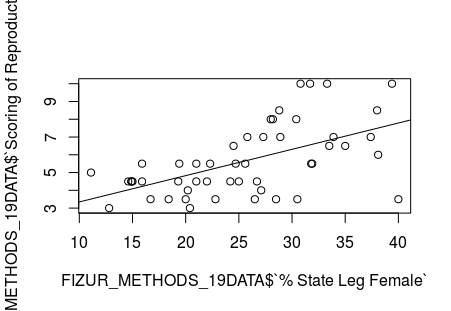
Statistical significance was found between the number of women in state legislature and the score that state received regarding reproductive rights. For example, for every 1-point increase in women’s representation in a state, there was a 0.075 increase in the reproductive rights scoring that state received. Therefore, although my hypothesis was not rejected it is important to compare these results to other control variables. Regarding party affiliation, for every 1-point increase in women representation, a decrease of 0.03 occurred regarding the percentage of republican representation. Similarly, when considering party ideology, for every 1 unit increase in women’s representation, there was a 0.03 decrease in the percentage of individuals that voted for President Trump in the 2016 election. Further, to be sure my independent variable and dependent variable were consistent, I compared the level of women representation with the ranking of Women Friendly legislatures provided by the Center for Women in American Politics. As I expected similar to the level of scoring of reproductive rights, for every one unit increase in women’s representation, there was a 0.03 increase in the CWAP Ranking. While my hypothesis that the greater number of women representations in state legislature would coincide with a greater level of reproductive rights legislation in a state was not rejected, this correlation does not mean causation. Furthermore, since the mean of the percentage of women representation in state legislature was only 25.48% and Nevada’s recent 52% majority is an exception and not the rule, this is an important relationship to continue to evaluate in the future as the average of women representation in state legislatures continues to climb. Currently the 25.48% of women representation in state legislature averages to a 5.64 score out of 10 in a state’s reproductive scoring. However, as more and more women continue to be elected, and specifically, more republican women, it is important to continue to take note of the influence and impact these women are having on women friendly policies such as reproductive rights.
Follow My Blog
Get new content delivered directly to your inbox.
 Jennifer's Political Science Blog